
Annie Dawid (anniedawid.com)
inkspot publishing (inkspotpublishing.com)
‘I’ll never forget that smell. Almonds. Almonds everywhere. You’d think it would stink. After everyone was dead, it did. But when the people were lining up and the doc and the nurses were getting everything ready with their little colored syringes and paper cups and all, it smelled good. Sweet. Didn’t smell like death. Like what the army guys started calling “Jonestown perfume” later on.’
The Peoples Temple Agricultural Project, more commonly known by its informal name ‘Jonestown’, was a remote settlement in the South American country Guyana, established by the Peoples Temple, an American cult movement under the leadership of Jim Jones. Jonestown became infamous globally when, on Saturday 18th November 1978, a total of 918 people were murdered or committed suicide at the settlement, at the nearby airstrip in Port Kaituma, and at a Temple-run building in Georgetown, Guyana’s capital city. Since that date, the name of the settlement has become synonymous with the horrific incidents that took place at those locations.
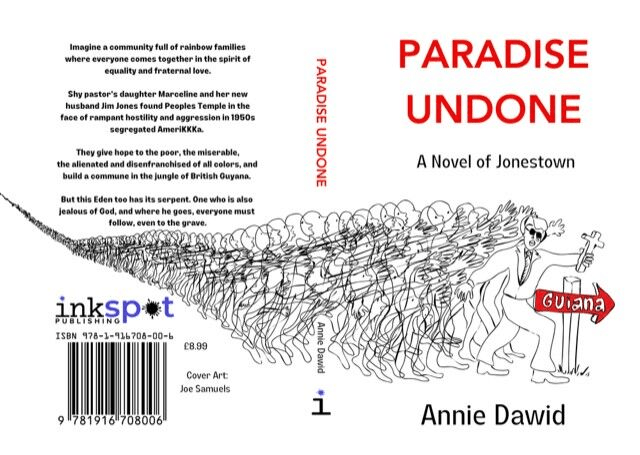
In honour of those fatalities, and in commemoration of those human beings who worked towards a Utopian ideal of a just society for all, Annie Dawid has written a moving and potent re-telling of those events, combining real and fictious actors in the Jonestown tragedy. Dawid privileges the perspective of four main protagonists, using their voices to convey a rounded and nuanced depiction of events. The novel opens with Watts Freeman, one of the few Jonestown escapees, interviewed by a public radio host about his experiences some decades after the massacre. We hear from Truth Miller, a white woman who cannot let go of her emotional commitment to Jim Jones and the Peoples Temple. A different perspective is provided by Virgil Nascimento, a fictional character based upon on Laurence Mann, the Guyanese ambassador to the United States. The most significant voice is that of the fictionalised Marceline, the emotionally abused wife of Jim Jones. It is Marceline’s account that gives us the backstory to Jim Jones’s rise as a cult leader and the development of the Peoples Temple. Crucially, it is Marceline’s perspective of an unfaithful and abusive Jim Jones that lays bare the hypocrisy and corruption at the heart of the Peoples Temple. As Marceline is trapped in a loveless and destructive marriage, so the members of the cult are enthralled and captured by Jones’s charismatic leadership.
Dawid uses the Truth Miller character to comment on the insidious and enduring nature of populist cults and their malign influence. Many years after the tragedy, Miller remains in the thrall of the late Jim Jones, viewing those who left the Temple as ‘traitors’. Despite the evidence of her own experiences, Miller refuses to break faith with Jones. In common with the late Marceline, Miller is trapped. She names here son Cuffy after the leader of an unsuccessful slave revolt in Guyana. The past is all Miller has and therefore she cannot accept that her adherence to the cult of the Peoples Temple was profoundly misguided.
Virgil Nascimento’s story demonstrates how far reaching and persuasive Jones’s narrative was. A senior member of the Guyanese establishment, Nascimento is duped into marrying Nancy, one of Jones’s acolytes. Following the tragedy, Nascimento finds that he cannot live with the knowledge that he remains in thrall to Jones through his marriage. Nascimento only finds escape in murdering his wife and child and committing suicide, the deaths an echo of the loss of the 918 lives on that day in November 1978.
Dawid skillfully conveys the gravitational weight of the mass suicides and murder by fragmenting and destabilising the narrative. The four main protagonist speak from various points of the timeline, before, during and after the massacre. Time is out of joint, with all perspectives and events dragged into commentary on that terrible day in November 1978. In effect, the past, future and present cannot escape that gravitational pull. All those touched by the tragedy remain haunted by it. The pre-massacre sections of the novel foreshadowing the mass suicides, tainted by the abortive hopes and futures of all those who lost their lives and those who survived, only to find that they remain trapped. The post-tragedy sections are indicative of the inescapable nature of such happenings. The past is inescapable. Some reviews have been critical of the abrupt way that the novel concludes. However, an abrupt and unresolved ending is entirely fitting. The massacre was obviously the most abrupt of endings, and one which denied survivors resolution.
Paradise Undone is ultimately a cautionary tale. We now live in a world dominated by charismatic populists who will stop at nothing to secure and maintain power and influence. All they need to prevail is the complicity of those they will inevitably betray. As the events of 18th November 1978 tell us, the price to be paid for that complicity is high and bitter.
 Precarious Gothic