
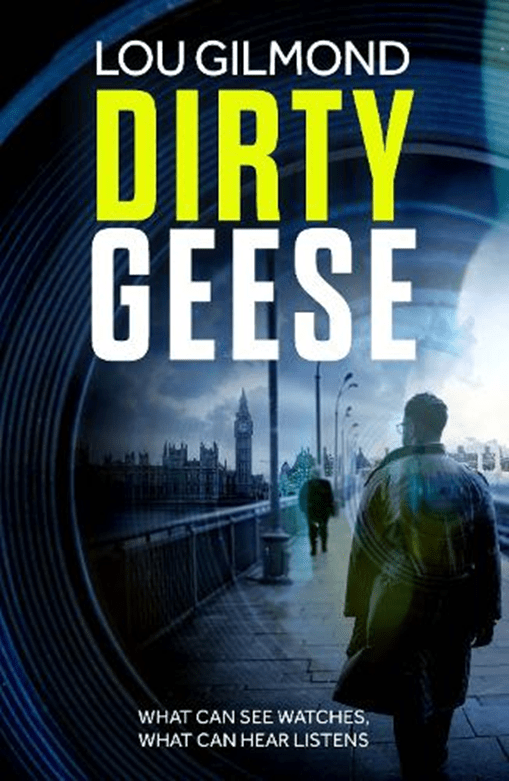
Lou Gilmond (lougilmond.com)
Fairlight Books (fairlightbooks.co.uk)
‘It’s me again. Percy Dvořáček. Do you know what I think, mmm? I think we’re all just stupid geese. Greedy. Waddling around pushing our stupid fat chests out, squawking across the House at one another, as if we mattered. As if we were important, but we’re not. None of us are. We’re too far behind. And we’re all dirty, aren’t we, hmm? … So what are we, eh? Just stupid, useless, dirty fucking geese. We don’t know anything, but they’re watching us, listening to us. And they’re inside my head, I tell you. And I don’t want them there.’
About his fictional private investigator, Philip Marlowe, Raymond Chandler wrote, ‘down these mean streets a man must go who is not himself mean, who is neither tarnished nor afraid. He must be, to use a rather weathered phrase, a man of honor—by instinct, by inevitability, without thought of it, and certainly without saying it.’ Lou Gilmond has given us a new man of honour, Harry Coleby. The ‘mean streets’ frequented by Harry are the corridors of power in Westminster’s Houses of Parliament, a place tarnished by greed, betrayal, mendacity, exploitation and innate corruption; a compelling if somewhat sceptical characterisation of the current state of British political life!
Following the suicide of the UK Minister for Personal Information, backbench MP Harry Coleby finds himself promoted to the Cabinet as the dead Minister’s replacement. Harry is immediately tasked with ensuring that his predecessor’s privacy bill makes it way through the parliamentary legislative process. However this will not be the first time that the proposed changes in law have been considered by the House of Commons. Shortly before his death, the previous minister appears to have tried to get the legislation passed as a private members bill, much to the consternation of the Prime Minister.
These events kick off a gripping political thriller, as Harry Coleby and Esme Kanha, the Government’s Chief Whip, are caught up in a miasma of intrigue, encountering Voter Services, a somewhat sinister organisation involved with their party’s electoral campaigning, using Alchemina, software that gets deep into voters’ minds.
This combination of recognisable political intrigue and advanced AI driven technology is remarkably effective. The rather down-at-heel qualities of life as a British parliamentarian are thrown into sharp relief by the wealth and power exhibited by those developing this technology, dependent upon access to our most private information.
In the tradition of George Orwell and John le Carré, Dirty Geese plays with a number of our key anxieties, including the loss of confidence in the British political system and the apparently relentless erosion of privacy as identities are available for trade and we are subject to what feels like 24-hour surveillance. Lou Gilmond manages the tension between these two themes well, adding into the mix personal challenges for Esme and Harry, including the toxic state of Harry’s marriage. As a consequence, Dirty Geese is both compelling and unsettling from the outset.
It’s good to know that more novels featuring Harry and Esme are planned.
 Precarious Gothic